
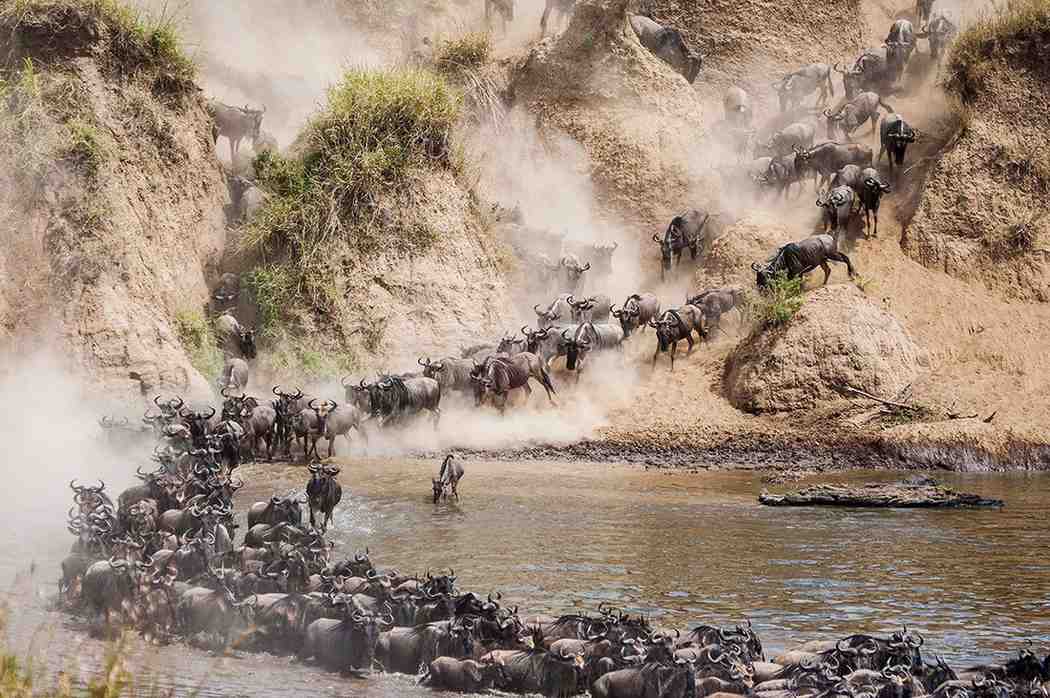
A river crossing is not a single dramatic afternoon that happens on schedule — it’s the outcome of thousands of animals building up along a riverbank, hesitating, and eventually committing, sometimes after hours of false starts. Understanding that process, rather than just the postcard image of it, makes for a much better-planned trip.
What’s actually happening
As the wildebeest herds move north through the Serengeti toward fresh grazing, the Mara River sits directly across their path — a genuine physical obstacle, not a staged one. Crocodiles wait in the deeper channels, the banks are often steep, and the herds’ instinct is caution rather than urgency. What triggers an actual crossing is not fully predictable: it can be a single animal breaking from the group, pressure building from the herd behind, or simply enough individuals reaching a threshold of confidence at once. Once it starts, it can be fast and chaotic, or it can stall and restart repeatedly.
When crossings typically happen
Crossings are generally associated with the July-to-October window, as the migration moves through the northern Serengeti and into Kenya’s Masai Mara, though the exact start can vary — some years see crossings begin as early as June, and activity can continue into September or later depending on rainfall and grazing conditions that season. There is no fixed date, and no operator can tell you in advance which specific day a crossing will happen, because the herd itself doesn’t know until it happens.
Where to watch from
Crossings happen at established points along the river, and depending on where the herd is concentrated in a given week, the better vantage point may be on the Tanzania side (northern Serengeti) or the Kenya side (Masai Mara). This is one of the genuine practical reasons the “Tanzania or Kenya” question comes up so often for migration-season travel — we go into the fuller comparison in Serengeti or Masai Mara: Choosing Between Tanzania and Kenya for the Migration.
What a realistic day looks like
Watching for a crossing usually means positioning near a known crossing point and waiting — sometimes for a short while, sometimes for most of a day, sometimes without a crossing happening at all that day. Experienced guides read herd behaviour (pacing along the bank, increasing agitation, animals testing the water) to judge whether a crossing is becoming more likely, but this is informed patience, not certainty. Multi-day stays near the river meaningfully improve your odds simply by giving more attempts.
Frequently Asked Questions
Can I guarantee seeing a Mara River crossing if I book for August?
No. August sits within the general crossing window, but no crossing can be scheduled or guaranteed. Staying multiple days near the river improves your odds considerably compared to a single-day visit.
Is it better to watch from the Tanzania side or the Kenya side?
It depends on where the herd is concentrated during your specific dates, which can shift within a season. See our Serengeti or Masai Mara comparison for the fuller trade-offs beyond just crossing access.
How long does a single crossing take?
It varies enormously — some crossings resolve within minutes once they start, others involve repeated hesitation and partial crossings over an hour or more. The build-up before a crossing begins is often the longest part.
Is it safe to watch — do crocodiles pose a risk to the vehicle or viewers?
Viewing is done from vehicles at a safe distance under guide supervision, following each park’s wildlife-viewing regulations; this is a standard part of how guided game drives operate near river crossing points.
What if I visit during the crossing season and don’t see one?
It happens, and a good guide will be upfront about that possibility rather than promising otherwise. The northern Serengeti and Masai Mara both offer strong general wildlife viewing independent of whether a crossing occurs during your specific visit.
Planning your dates around crossing season? Our team can help you weigh the Tanzania and Kenya sides against each other and build in enough days near the river to give yourself a realistic chance. Request a tailored quote or use the custom safari planner.