
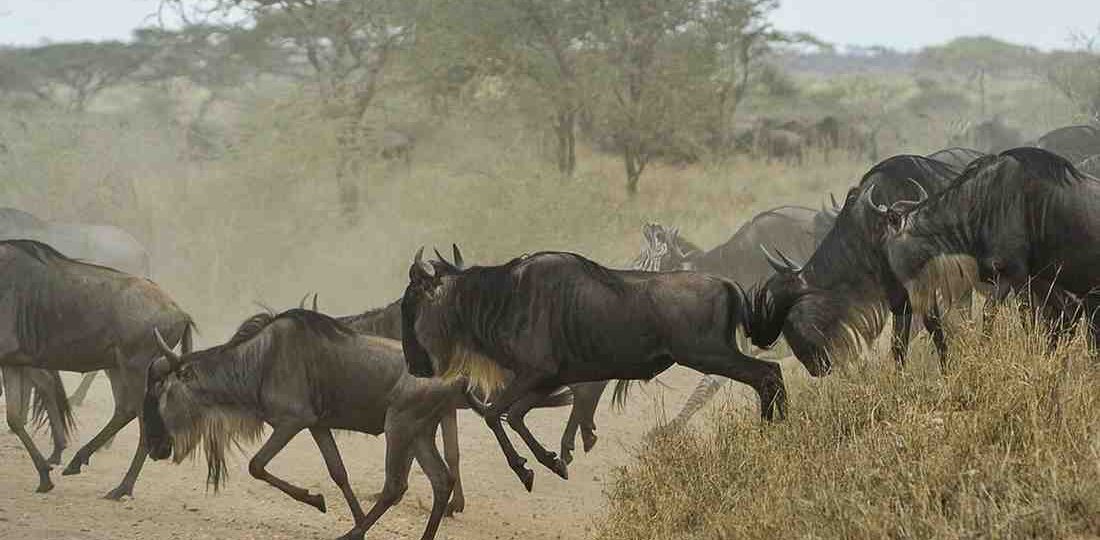
Ndutu isn’t a national park in its own right — it’s an area straddling the boundary between the southern Serengeti and the Ngorongoro Conservation Area, and for a few weeks each year it becomes one of the most concentrated wildlife scenes in East Africa. That concentration is the whole point of planning a trip around calving season, and it’s worth understanding what’s actually happening before you build an itinerary around it.
What calving season actually is
Each year, the migratory wildebeest herds gather on the short-grass plains around Ndutu, drawn by nutrient-rich grass that grows after the short rains. It’s here, generally through a window concentrated in January and February, that the majority of the year’s calves are born — a synchronised birth pulse that can see thousands of calves arrive within days of each other. That synchrony is itself a survival strategy: predators simply can’t take advantage of every vulnerable newborn when so many appear at once.
For a visitor, this translates into two things happening simultaneously — genuinely charming scenes of newborn wildebeest finding their feet within minutes of birth, and equally genuine predator activity, as lion, cheetah and hyena take advantage of the concentration of prey. It is not a soft-focus wildlife experience. It’s a real demonstration of how this ecosystem actually works.
When to go
The exact timing shifts a little year to year with rainfall, but the general pattern places peak calving activity in the January – February window, with strong wildlife density persisting through the surrounding weeks as the plains stay green. This is described in more context, alongside the migration’s other phases, in The Great Migration, Month by Month.
Where you actually stay and drive
Ndutu sits close enough to Ngorongoro Crater that many itineraries combine the two, using the Crater’s rim-area lodges or camps closer to the plains themselves as a base. Because Ndutu is technically split between Serengeti National Park and the Ngorongoro Conservation Area, permit and driving rules differ slightly depending on exactly where you are — something your safari planner will factor into the route rather than something you need to memorise in advance.
What this season is not
It’s worth being direct about two things calving season is not. It is not a guaranteed birth-on-camera experience — you may see newborns minutes old, or you may see calves already a few days into finding their strength, depending on timing within the season. And it is not a crowd-free experience — Ndutu’s reputation means camps in the area book up well ahead of the January – February peak, so planning early matters more here than in many other parts of Tanzania.
Frequently Asked Questions
Is Ndutu a separate park I need a different permit for?
Ndutu spans the Serengeti – Ngorongoro boundary, so your itinerary may cross both jurisdictions depending on exactly where camps and drives are based. This is handled as part of route planning rather than something you need to arrange separately.
Will I definitely see wildebeest being born?
No sighting can be guaranteed. Calving is concentrated in a general window, not a fixed date, and specific births happen unpredictably within it. Strong general wildlife density during this period is a much safer expectation than a specific birth sighting.
How does Ndutu compare to visiting the Serengeti at another time of year?
Ndutu’s calving-season concentration is genuinely distinctive, but the wider Serengeti offers strong wildlife viewing across most of the year — calving season is a specific, additional draw rather than the only reason to visit.
Can Ndutu be combined with Ngorongoro Crater in one itinerary?
Yes, and it commonly is, given the proximity. See our Ngorongoro Crater safari page for more on that combination.
How far in advance should I book a calving-season safari?
Given how far ahead camps in the Ndutu area typically fill for the January – February peak, earlier planning — often many months out — generally gives you meaningfully more accommodation choice.
Weighing a calving-season trip against other times of year? Our team can help you compare the Ndutu window against the wider Great Migration calendar and match it to the dates you have. Request a tailored quote to start the conversation.