
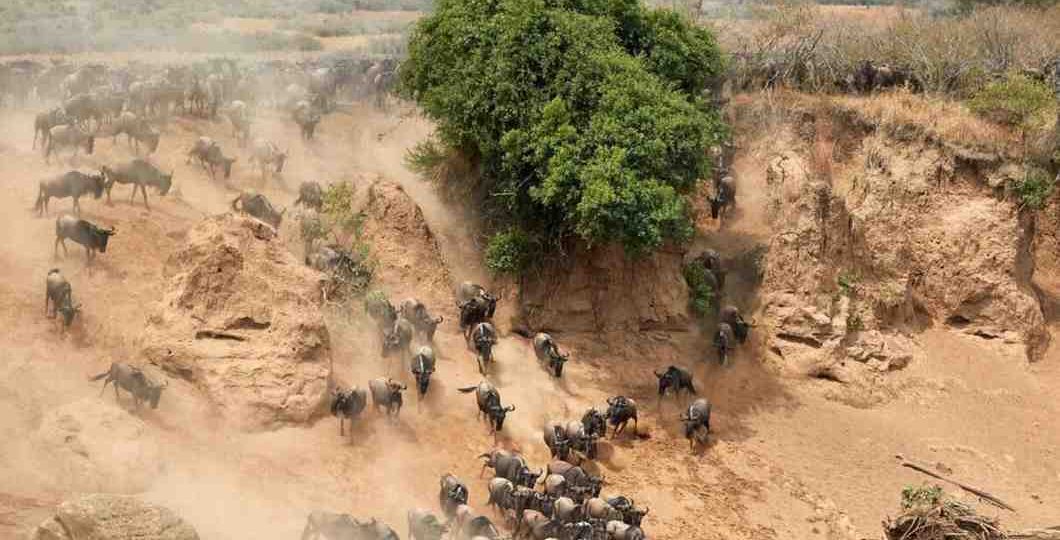
People often ask when the Great Migration “happens,” as though it were a single event with a date attached. It isn’t. It’s a continuous, year-round movement of roughly two million wildebeest, zebra and gazelle across the Serengeti-Mara ecosystem, following rainfall and fresh grazing in a rough, repeating loop between southern Tanzania and southern Kenya. There is no month when the migration is absent — only months when it’s somewhere different, doing something different.
That distinction matters more than it sounds like it should, because it changes what question you’re actually answering when you plan a trip around it. “When is the migration?” isn’t really answerable. “What do I want to see, and when does that particular phase usually happen?” is.
This guide walks through the migration’s general seasonal pattern month by month, so you can match your travel dates to the phase that interests you most — river crossings, calving, or simply strong general wildlife density — rather than chasing a single headline event.
A word on certainty, first
Every date range below describes a general pattern, built from repeated observation over many years, not a fixed calendar. Rainfall varies year to year, and the herds respond to where grass is growing, not to a schedule. A river crossing that “usually” happens in late July might happen in June or hold off until September. No operator — including Ibhanilfa — can guarantee a sighting of a specific migration event on a specific date. What we can do is help you plan around the odds, using the general pattern that has held reasonably consistently over time.
December to March: the southern plains and calving
From around December, the herds are typically spread across the short-grass plains of the southern and eastern Serengeti, particularly around the Ndutu area on the Serengeti – Ngorongoro border. This is where calving is concentrated, generally peaking in the January – February window, when a large share of the year’s calves are born within a short span of weeks. It’s an intense period for predator activity, since so many vulnerable young animals are moving together.
This phase rewards travellers who want to combine wildlife density with relatively short travel distances from Ngorongoro Crater and the southern Serengeti. We cover it in detail in Ndutu and the Southern Serengeti: Planning a Calving Season Safari.
April to June: the move north
As the short rains taper and the southern plains dry out, the herds begin moving north and west through the central and western Serengeti, generally reaching the Grumeti River area by around May or June. This is a genuinely underrated window: wildlife density remains strong, rain has usually eased the worst dust and heat, and the crowds that build up around the Mara crossings later in the year haven’t yet arrived. It’s also, not coincidentally, when green-season travel becomes a genuinely appealing option for value-conscious and crowd-averse travellers.
July to October: the Mara River crossings
This is the phase most people picture when they hear “Great Migration” — the herds massing on the banks of the Mara River, working up the courage to cross into Kenya’s Masai Mara, with crocodiles waiting in the water and predators watching from the banks. Crossings typically begin as early as June in some years, build through July and August, and can continue into September or even October, with the exact timing driven entirely by where the grass and water are best that particular season.
It’s worth being honest about what this actually involves as a traveller: crossings don’t happen on a schedule, they can take hours of waiting for a herd to build the confidence to cross, and a crossing witnessed from one vantage point on one day might not repeat the next. We go into this in full in Mara River Crossings Explained, including the practical difference between watching from the Tanzania (northern Serengeti) side and the Kenya (Masai Mara) side — a decision covered separately in Serengeti or Masai Mara: Choosing Between Tanzania and Kenya for the Migration.
November: the short rains and the turn south
As the short rains arrive, typically from around November, the herds generally begin moving back south, retracing a broad version of the same route toward the plains where calving will begin again. This transitional period is less predictable and less heavily marketed than the crossings or calving season, but it can offer strong game viewing with noticeably fewer vehicles.
A simplified reference table
| General period | Typical location | What defines it |
|---|---|---|
| December – March | Southern & eastern Serengeti (Ndutu area) | Calving concentration, high predator activity |
| April – June | Central & western Serengeti | Movement north, Grumeti River crossings possible |
| July – October | Northern Serengeti & Masai Mara | Mara River crossings |
| November | Southern Serengeti (return) | Short rains, herds moving south again |
This is a guide to pattern, not a promise. Treat it as the framework you plan around, and confirm current conditions with your safari planner as your dates approach — that’s exactly the kind of adjustment a tailored itinerary is meant to accommodate. For a broader look at Tanzania’s seasons beyond the migration specifically, see Best Time to Visit Tanzania.
Frequently Asked Questions
Is there a single “best month” to see the Great Migration?
Not really — it depends what you want to see. July through September gives the strongest odds for river crossings; January and February concentrate calving; April through June offers strong wildlife density with fewer crowds. Each phase has a different character.
Can I be guaranteed to see a river crossing if I visit in August?
No. August is generally within the crossing window, but crossings happen on the herd’s timing, not a booking calendar. Some visitors see multiple crossings in a few days; others see none in a week. This is worth planning for honestly rather than being promised something no one can control.
Do I need to choose between Tanzania and Kenya to follow the migration?
Not necessarily — the herds move between both countries during the year, and which side makes sense depends on your travel dates. See our comparison of the Serengeti and Masai Mara for how to think about that decision.
Is the migration less interesting outside the crossing and calving windows?
No — the Serengeti ecosystem supports resident wildlife year-round, and the “in-between” months (April – June, November) often mean fewer vehicles at sightings, which many experienced safari travellers actually prefer.
How far in advance should I book to target a specific migration phase?
Because migration-adjacent camps and lodges near Ndutu and the northern Serengeti book up well ahead of their peak windows, earlier planning generally gives you more accommodation choice. Our Tanzania safari cost guide and custom safari planner can help you weigh timing against availability.
Planning around a specific phase of the migration — calving, a crossing, or simply strong general wildlife viewing? Our team can help you compare timing, routing and safari styles against the dates you actually have available. Request a tailored quote or get in touch to talk through what fits.