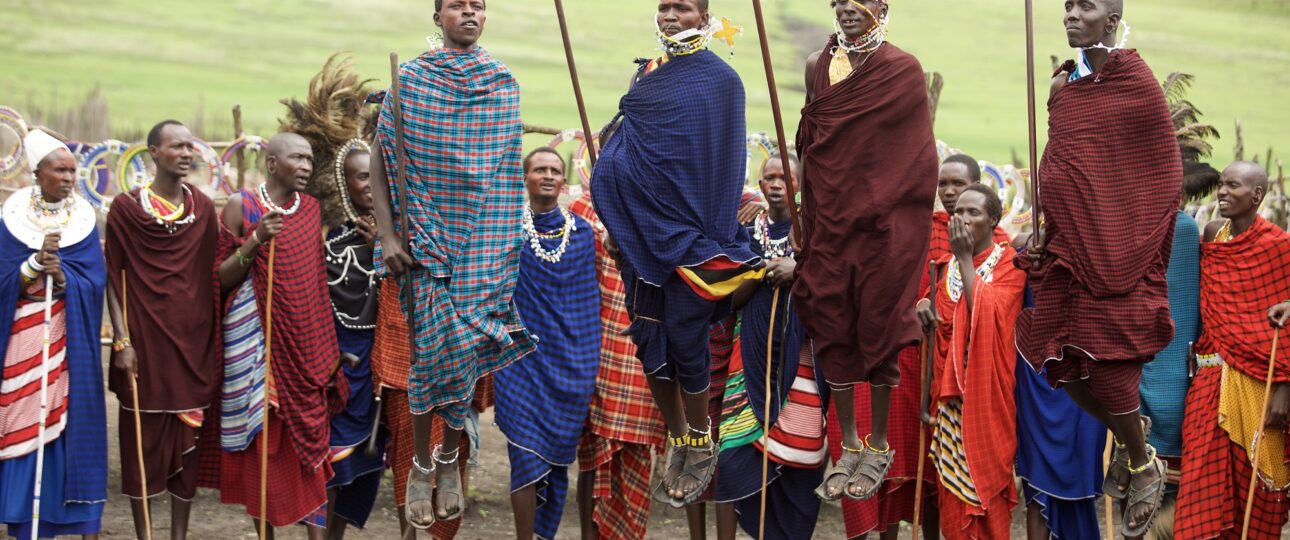
Cultural tourism in Tanzania is often marketed with a shorthand that doesn’t hold up to scrutiny — “visit an authentic tribe,” as if entire, diverse, living communities exist primarily to be observed. They don’t. Maasai and Hadzabe communities are contemporary people with their own priorities, economies, and relationships with tourism, some of which are genuinely welcoming to respectful visitors and some of which are not interested in tourism at all. Approaching this thoughtfully changes both what you should expect and how the visit should be arranged.
Who you might encounter, and how they differ
Maasai communities are semi-nomadic pastoralists whose traditional range spans parts of northern Tanzania and southern Kenya, closely associated with the areas around the Serengeti, Ngorongoro, and the wider northern safari circuit. Many Maasai today live at the intersection of traditional pastoral life and the modern Tanzanian economy — some deeply engaged in cattle-herding traditions, others working in tourism, education, or other sectors entirely. There is no single “Maasai experience,” any more than there’s a single experience of any large, diverse population.
Hadzabe communities, based primarily around Lake Eyasi, are among the last remaining hunter-gatherer societies in East Africa, with a language and way of life genuinely distinct from neighbouring pastoralist and agricultural groups. Their population is small, and tourism’s role in their community varies considerably by specific group and arrangement — this is explored in more depth in The Datoga and Hadzabe of Lake Eyasi, which also introduces the Datoga, a neighbouring pastoralist community often overlooked in favour of their more widely marketed neighbours.
What a responsible visit actually looks like
The clearest marker of a responsible cultural visit is consent and genuine economic benefit reaching the community involved, not just a tour operator. Practically, this means: visits arranged through or with direct benefit to the specific community rather than a generic “cultural stop” with no clear beneficiary; photography handled according to the community’s own preferences, asked for rather than assumed; and an experience framed as a visit and exchange rather than a performance staged purely for cameras.
It’s also worth being honest that some encounters marketed as “authentic” are, in practice, more performative than others — this isn’t necessarily dishonest (some communities have deliberately built cultural-demonstration programmes as a genuine, chosen income source), but it’s worth understanding what you’re booking rather than assuming every visit reflects unmediated daily life.
What this looks like at Ngorongoro specifically
The Ngorongoro Conservation Area is a distinctive case worth understanding on its own terms — it’s one of the only protected areas in Tanzania where wildlife conservation and Maasai pastoral life are managed together under a single “multiple land use” model, rather than communities being excluded from the protected area entirely. We go into this in detail in The Ngorongoro Conservation Area: Where Wildlife and Maasai Communities Coexist.
Questions worth asking before booking a cultural visit
- Does a meaningful portion of what I’m paying reach the community directly, rather than only the tour operator?
- Is photography consent-based, and will I be told the community’s preferences before I arrive?
- Is this visit framed honestly — as a paid cultural exchange or demonstration — rather than presented as if I’m observing unstaged daily life?
- Am I given context about who this specific community is, rather than a generic “tribal visit” label that erases meaningful differences between groups?
Frequently Asked Questions
Is it appropriate to take photographs during a cultural visit?
This depends entirely on the specific community’s preferences, which should be communicated before the visit — never assume photography is welcome by default, and always ask rather than photograph without clear consent.
Do Maasai communities all live the same traditional lifestyle shown in tourism marketing?
No — Maasai communities today range widely in how they combine traditional pastoral life with participation in the modern economy. Tourism marketing sometimes flattens this diversity into a single image, which this article deliberately avoids doing.
Is visiting the Hadzabe exploitative?
It depends heavily on how the visit is arranged and whether meaningful benefit and genuine consent are part of the arrangement — this is a fair concern to raise directly with any operator, including us, before booking.
Does money from cultural tourism actually reach the community?
This varies by how the specific visit is arranged. It’s a reasonable and important question to ask directly rather than assume either way.
How does this connect to Tanzania’s national parks?
Some areas, most notably Ngorongoro, manage wildlife conservation and community pastoral life together within the same protected area — a distinctive model covered in our Ngorongoro article.
Interested in including a cultural experience in your itinerary, arranged thoughtfully? Get in touch or request a tailored quote to talk through the options.